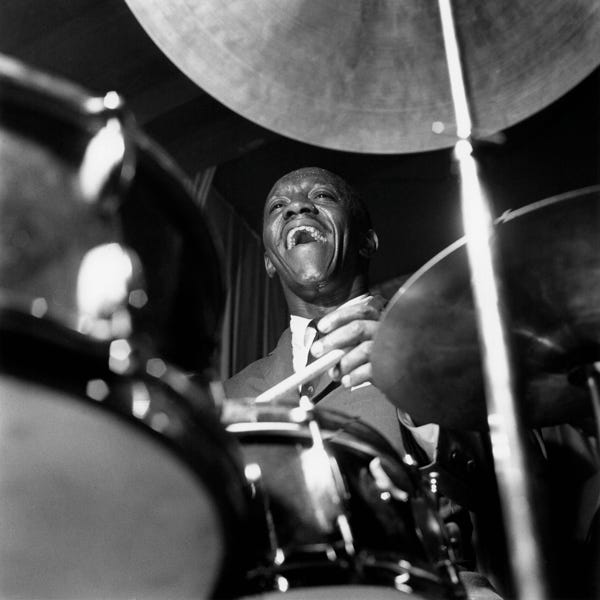
(This is an oldie. It’s one of my favorites.)
“Who’s Art Blakey?” you ask? OK, you must not be a jazz fan. Art Blakey is one of the seminal figures in modern jazz, from the 1940’s to 1990 when he died. I was lucky enough to see him play live with his iconic group The Jazz Messengers. You can see a list of his alumni in the Appendix.
Do you find managing programmers to be like herding cats? Or are you afraid of the day when you’ll be asked to do it and thinking, “Oh, no, I don’t know how to be this guy:
or him:
or him: “
Let’s learn from the master. Blakey did it for 33 years. It’s hard to find a jazz great who did not play with the Messengers. Maybe he can teach you a thing or two.
Hint: it’s not like any of those examples. But you probably figured out that’s now where we’re going.
Is Programming Really Like Jazz?
You hear management “experts” (aka “grifters”) blather about how “programming teams should be organized like jazz groups,” like this or this. They’re not totally wrong, but their analysis is all on the surface, like this:
Since its start, jazz has been characterized by improvisation. Jazz musicians learned to rely on the essential elements of a song only. They constantly play variations on the main theme, listening to ideas from other players and reacting to them, in order to create exciting and moving music. In a VUCA world, modern, agile organizations should be like jazz combos: reacting to, and anticipating rapidly evolving competitive scenarios, in order to create value and competitive advantage.
or this:
In jazz music, there is less hierarchy overall and the group tends to be much smaller. A jazz ensemble has dispersed decision making—it is pushed down from the “leader” to the “individual.” This approach works well when flexibility, responsiveness, innovation, and faster processing of information are needed. Unlike in classical music, the jazz environment is not as structured. Yet, like classical musicians, the individual in jazz music still needs to excel within the environment. All of these skills enable the project manager to balance between disciplined and agility methodologies.
This sounds great if you don’t know anything about jazz: hey, it’s “creativity!” and “unstructured!” and “improvisation!” But now we’re going to hear from some people who actually do jazz (or did it, in the case of Blakey, RIP, may his memory be a blessing). It turns out that there’s a lot more to learn than those cliches.
So How Did Blakey Do It?
Mentoring
“Mentoring” is a word that MBA’s and management “experts” like to throw around. “Young women need to get a mentor like the men have!” they say. I think they imagine the mentor as someone who gives you praise no matter what you do, like Mom at the park who watches her daughter do a cartwheel and says, “Good job, honey!” That’s not Blakey. And that’s probably not the kind of mentoring a young professional needs, either.
Here are some of the young stars he mentored talking about the experience:
Blakey’s “young lions” frequently depict him doling out tough love as a quasi-father figure. Although Blakey’s comportment during his golden years was not exactly equivalent to the persona of, say, Fred Rogers, he had, Workman observed, “matured as a person.”
“I’d heard stories about how intense Art could be, but he wasn’t like that with us,” Pierce said. “He was a great manipulator. He was gifted at seeing what people needed to feel, so that he could get the most out of them. But I think he genuinely thought, ‘These are young, dumb assholes; I’d better help them out.’ The earlier guys were more or less his peers, or at least they tried to behave that way. We didn’t see ourselves as Art’s peers. We wanted to be in the company of the great man and learn as much as we could.”
A real mentor gives you a strong impression that they could do your job as well as you can; they just prefer to teach you how to do it.
“Art taught in the Socratic manner,” Branford Marsalis said. “He’d force you to think, and through thinking, you arrive at the answer.”
“He mirrored your personality back at you,” Harrison said. “If you were selfish, Art might show you that you’re selfish. He’d paid attention to all the people he’d been around. He told me: ‘When you get your band, make sure you realize every person is different, and don’t lose them. Figure them out, and nurture them until they get where they’re going.’ He told me things about the alto saxophone that nobody else ever told me—how to play with a trumpeter, how to play dynamics, how to use your throat. You’d have thought he was a saxophone teacher.”
Donald Brown recalled a rehearsal when Blakey deployed his piano background: “Art asked if I could voice the chord to give it more weight. I wasn’t sure what he was talking about, so he came over and demonstrated. For him to do that was a lesson you can’t put a price on.”
Still, Blakey mentored most effectively from the drum chair, backing up words with deeds. “He’d talk you through your solo, saying things like ‘play the blues’ or ‘double up,’ giving guidance on how to make your moves,” Harrison said.
Presenting Your Project
Almost every team has to present their work to others in the company sooner or later; and frequently it’s to the leader’s own managers and colleagues. Those moments are crucial to the team’s reputation. Often that’s all they see of you, and we ought to look at those presentations like performances.
Valery Ponomarev played trumpet with the Messengers around 1980; here he is with his own group. He wrote a book about his experiences with Blakey. It’s organized around Blakey-isms, or those things Art always used to say. One of them is about knowing what you’re going to do before you get on stage:
NEVER ASK IN FRONT OF THE AUDIENCE “WHAT DO WE PLAY NEXT?”
“What is this song?” “How does that one go?”or “What key?” Never teach the music in front of the audience. At a jam session you can, but not at a concert with a high profile band.
To the audience it means you don’t know what you are doing.
…
Musicians should know their repertoire before stepping on the band stand. Not any kind of a crib on the stage either. Uh, uh! Benny Golson once told me a story of the Messengers sitting in a circle and memorizing the tunes. They actually collectively practiced memorizing their repertoire. I heard that story years after leaving the band but always knew that Art Blakey did not invent that “stage rule” just for our generation of the Messengers. Benny Golson was talking about Lee Morgan, Bobbie Timmons, Jymie Merritt, the classic edition of the band, my heroes, before recording in 1958 one of the greatest Jazz Albums ever - Moanin’ .
The Messengers had never even had music stands on the stage. The band projected confidence. People were happy to have paid whatever money they paid for the show. They were put in the right state of mind from the very beginning.
When you present your project, looking prepared, professional, and organized makes a big, big impression on people. More than you’ll ever realize, probably, until you meet someone a year later who tells you, “Hey, I saw you guys a year ago. You really had it together!”
Giving Your People the Spotlight
One big problem I have with the “leadership” lessons we see online is an attitude that’s not even stated: “It’s all about me! I’m the leader. See? I’m exerting leadership.” That’s not the way Blakey did it. Your people have careers, too. It’s not all about you.
When you have one of those “performances,” don’t do all the talking. Your people need to learn the skill of presenting their work, even if they hate it (and they probably will). Show them this article I wrote. They might pretend to hate being given the spotlight briefly, but believe me, it’s a big moment in their career. Walk them through it ahead of time.
Public speaking for engineers like them is nothing like all those “lessons” like to tell you.
An aside: this is taking it to an extreme and I’d really love to see some programming group try this, but it would definitely be an over-the-top ego trip. In a Muddy Waters show like this, the band is introduced first and they do two or three songs without him. Then he makes his entrance:
“What about a big round of applause for the father of the blues, ladies and gentlemen: Muddy Mississippi Waters!”
Once Muddy said, “I don’t have to sing all night. I got me an all-star band!” That’s the image you want to cultivate: your people are so good, you don’t even have to speak!
Blakey is best known, probably, for all the superstars he launched. Valery says,
For your feature he would make the most generous announcement and tell the audience: “He has chosen for his musical vehicle” then followed the title of a tune Art knew would feature you the most.
It’s your people’s time to shine. Let them enjoy it.
I never heard Art giving instructions nor advice in front of the audience. Only “off the record”. Every one of us heard Art’s “It’s your feature” meaning, when its your turn to be center stage, be that center of attention. Don’t give extra time for the piano or other instrument to play as long or longer than you. “They will have their turn. Don’t confuse the listener.” Give the piano trio or the bass 8, OK 16 bars, and that’s it. Come back and finish your presentation.
But It’s Not All About Them, Either
Here the Messengers are in 1958. Note what the sax player (Benny Golson) does while the trumpet player (Lee Morgan) is soloing: he listens. He faces the audience.
Now Morgan finishes and Golson takes his solo. Does Morgan get off the stand, check his watch, and otherwise looked bored? No, he faces the audience, too.
Now for a bad example, look at this video of the Miles Davis group in 1964:
OK, Miles is an extreme example. “Don’t turn your back on the audience” is a Blakey-ism, and Miles was infamous for flouting that, e.g. at 4:46.
At 8:58 Wayne Shorter finishes his solo and walks to the back of the stage, turning his back on the audience.
This and the previous section are the key: everyone gets their time to shine, but when that time is over, they listen to and support whoever’s having their time. Valery says:
When you are done with your solo, the music still goes on. Take a bow and move backwards, still facing the audience. Do not turn your back on the fans. You wouldn't like it, would you? So, they wouldn’t either. Yes, I know what you are going to tell me - How about Miles Davis turning his back to the audience? Yes, that’s true, Miles Davis is known for that. But that’s an exception to the rule. He is known for breaking rules, too. I don’t think there has ever been a rule without an exception.
Anyway, do not turn your back to the audience. That’s it. Do not turn your back to your band mates either, do not stand in front of a soloist. Oh, please! Don’t do that. Remain on the stage, though. Find yourself a comfortable spot and remain there. The music still goes on. Concentrate on that. Listen to what the others are playing. You cannot look indifferent. You are a part of it, even if you are not playing at the moment.
If You Have Fun, They’ll Have Fun
This seems to go unnoticed by the “management” writers: they make you think if you’re a buttoned-up, serious, boring, always-correct executive, it’s all good. Wrong.
That’s not Blakey’s attitude. Watch this 1980 interview with him.
If I take a vacation and if I am off eight nine days, I'm ready to climb walls. I have to do because that's my job. That's what I love. It's like anything else. If a person loves what he's doing, just do it. It's not a job to me, I just enjoy it.
You can’t fake this. Having yet another “team-building” session at the Laser Tag place is not going to substitute for enjoying your regular work all day long.
Real teams don’t need team-building days.
That says it all. Forcing people to pretend to be friends when they’re just work colleagues is a modern form of worker abuse. You build the team by having them be a team.
Character Matters
This is another word that’s out of fashion. How did Blakey pick all those people who went on to be superstars? He couldn’t work his magic on just anyone. He’s quoted in this video as saying,
I look for the character of a person mostly, his talent, and that's it. If his character ain't right I don't have anything to do with him. Just like anything else I don't care where he comes from or what he looks like. If he's got the talent and good character he can work with me.
You want your people to remember their time with you fondly, like Wynton Marsalis remembers Blakey.
It’s Not All Improv. You Have to Prepare.
You might get the idea from the “management should be like jazz” articles that your people want to be “creative” and you just need to loosen up. They even give you the idea that a jazz soloist is making it all up in the moment.
Well, it is creative, but not the way you think. Valery says,
Do some research, study how your favorite musical heroes worked on their solos well before they recorded them. You doubt Dizzy Gillespie, Clifford Brown, Freddie Hubbard, Lee Morgan (and the list goes on and on) worked on their solos prior to recordings? You do? Listen to alternate takes, then. Sometimes takes number 2, 3, 4 etc. are the exact repetitions of the main take or at least very similar in content, no matter how many takes there are available. What does it tell you? Your favorite, a musical hero of yours, worked very hard on this or that phrase, chord substitution, melodic or rhythmical pattern etc. in preparation for this particular recording session. In advance!
Have you ever heard some “teacher” saying, “think when you play?” OK, then. Try to think when the chords are already moving and passing by at the speed of at least 66 beats per minute. Go ahead, try to think what to play over that chord. It did take you a sec to figure out the chord. A sec at best. It may take much longer. OK, you came up with a decision. Now what are you going to play over it? Oh, yes? That phrase, those notes, that dynamic, that register, out of the “inside” scale, “outside”...??? How long will it take you to realize that the chord in question is already gone, you missed it already, a while ago! At best, if you worked on similar chord progression, form, etc. you might be able to work it out like a “puzzle”, fast. But! It’ll still take you a moment and the notes will sound not exactly in sync with the rest of the band. Particularly not with the rhythm section - the time, chords, pitch etc. Precision is definitely not there. The “Music Is a Collective Product Rule” is not even broken, but totally neglected and disrespected. Breaking rules is one thing. Neglecting them, disrespecting them is another.
“Think while you play”? - Nope, wrong! It is too late to think when you are already in the whirlpool of playing. But this doesn’t cancel the thinking process at all. How? I just demonstrated it to you - you think before you play. For the most part well before you are in a playing/recording situation. Take it from the masters. You study everything, study well and you will never be caught again playing the same meaningless scales, all in eighth notes, or the same scale patterns chorus after chorus, again and again. And deceiving yourself or imagining yourself this great player or that one and boring the audience to death.
I’m not Art Blakey!
No, you’re not. Neither was I when managing. I’m not going to claim I always lived up to these ideals, either. We’ll close this by dealing with some of your objections.
Before we go into that: in my career, I became a manager four times, and I gave it up voluntarily four times. Management is not a linear progression where you only go up until you reach your level of incompetence. That’s what they want you to believe, but it’s not true.
A lot of managing sucks. Many long-time managers you’ll encounter don’t admit that it sucks, and instead lie to themselves.
When we talk about “managing” here, we’re only talking about first-level team leaders. At higher levels, probably many of the same principles apply, but you have much less direct control than a first-level manager. I have nothing to teach about that.
I Didn’t Pick These People!
Blakey got to choose his players. You might not have the luxury of choosing the people who report to you. What do you do?
I don’t know. That’s one of the things that sucks about managing, and probably one of the reasons I always got out of it.
I know a guy who was very successful in management in many different jobs, and he quotes a guy, “If someone offers you a req [requisition, i.e. an open position], take it.” That’s the way you have to be, I guess. Not me.
I Hate This Job!
Quite often, your team gets a task that they hate, and you hate it, too. So my comments about having fun might ring hollow.
There isn’t any magic answer to this, either. If your other Blakey qualities are there, the team might put up with it for a while if they believe better days are ahead. Above all, don’t pretend to like the task when you don’t.
If I Put My People Out There, They’ll Get Poached
Let’s say you do what Blakey did, and give the spotlight to your people. Won’t that mean other people in the company will hire them away from you?
Yes, it might. That’s good. The best part of your job is helping people succeed. Why wouldn’t you want that? In fact, you should encourage them to look around at least once a year.
Another Blakey-ism is, “This isn’t the Post Office.” He meant that playing with Messengers was not a lifetime job. Neither is working for you. At some point, the birds have to leave the nest.
Eventually, maybe you can be like Blakey, and have a reputation as the person who takes promising beginners and turns out superstars! All the best newcomers will want to work for you. Wouldn’t that be cool?
Appendix: Jazz Messengers Alumni
Art’s soloing, but the other guys are playing along.
These are some of the jazz stars who came out of the Jazz Messengers.