
Night Train to Lisbon

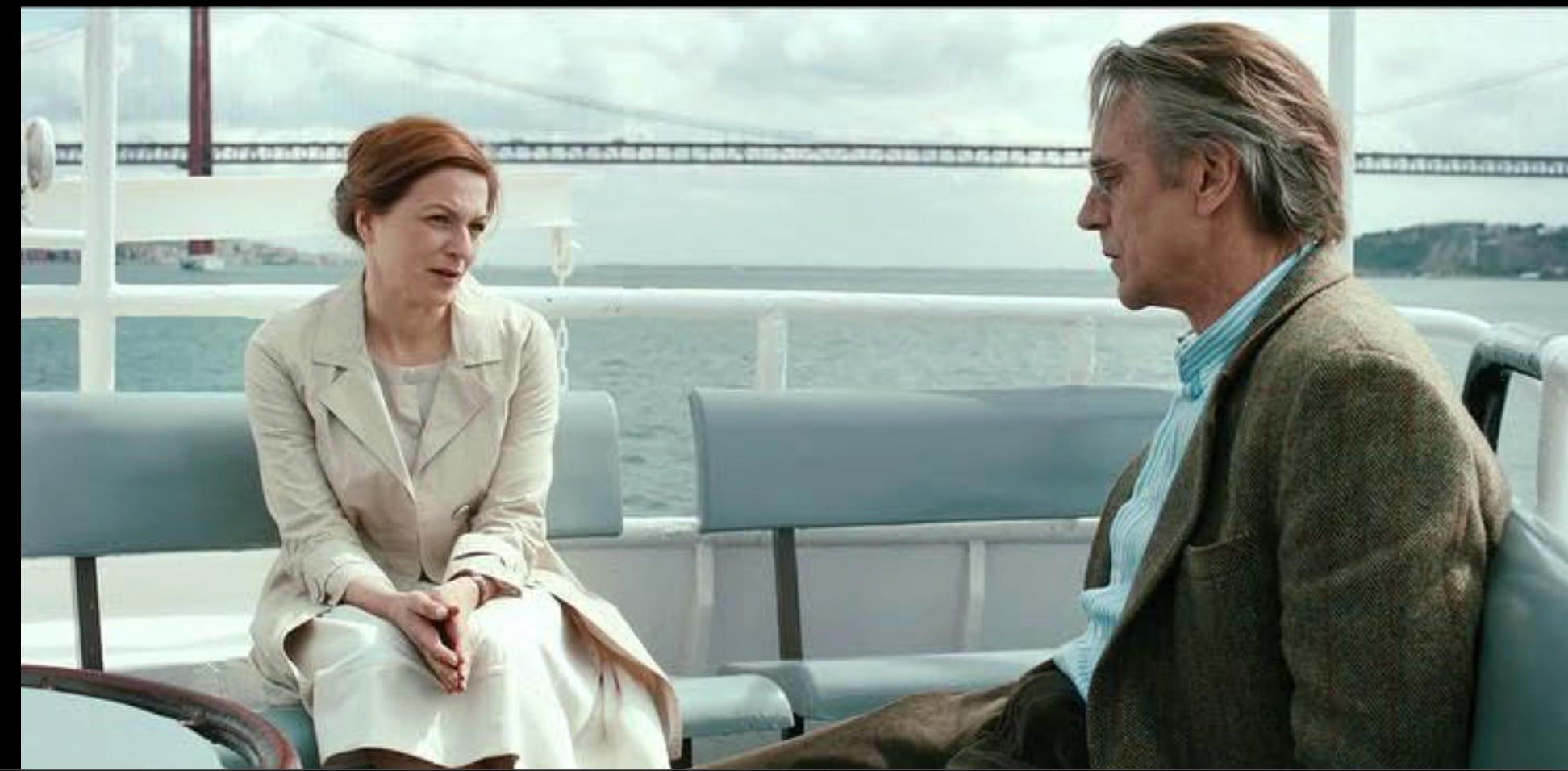
Do you ever love a book (and a movie) that everyone else seems to hate, at least in the English-speaking world? That’s Night Train to Lisbon for me. I don’t normally think of myself as a European in sensibility. But I loved the book and the movie. Your mileage may vary.
The book was a huge hit in Europe. As Amazon says:
A major hit in Germany that went on to become one of Europe’s biggest literary blockbusters in the last five years, Night Train to Lisbon is an astonishing novel, a compelling exploration of consciousness, the possibility of truly understanding another person, and the ability of language to define our very selves.
But as the New York Times said about the movie (which features Jeremy Irons),
Yada yada yada
The Guardian said,
And Now … Ladies and Gentlemen. Irons has a soft spot for these hokey dramas, and I admit I have a soft spot for his appearances in them. On TV, this might while away a rainy Sunday afternoon.
I like Jeremy Irons. So sue me.
The movie was directed by Bille August, who also did 55 Steps, Smilla’s Sense of Snow, Pelle the Conqueror, and many others.
With All That
What is it that these Media Elites hate so much? And why might you like it in spite of them?
Night Train to Lisbon, the book, was written by Pascal Mercier, the pen name of Peter Bieri (RIP), who was a professor of philosophy. It was published in German as Nachtzug nach Lissabon in 2004 and was translated into English in 2008. The fact that Mercier is a philosopher explains a lot. The book is about words, and how they shape people’s identity. One man, a professor of ancient words, investigates another man’s life, through his words, and also the people who knew him. It’s well to remember that the author is a professor of philosophy, not literature.
Raimund “Mundus” Gregorius is a 57-year old teacher of ancient languages: Latin, Greek, and Hebrew, in a gymnasium in Bern. When he first learned his specialty, he loved knowing the precise meanings of these words that no one uses anymore. To each his own.
He’s been teaching for 30 years and is enormously respected, although no one would say they “know” him. His wife left him five years ago because she thought he was boring. Students playfully call him up in the middle of the night and ask him some impossibly obscure question, and he always knows the answer and gives it thoughtfully and completely, and doesn’t resent the intrusion at all.
One rainy morning on a bridge he sees a woman apparently about to take her own life, and rushes to save her. She’s Portuguese, and he brings her to his class, which amuses the students. She eventually disappears and he follows her, with the class still in session, but not before she leaves him a clue to a book which he finds in a local bookstore. It’s in Portuguese, which he doesn’t speak, but he laboriously translates it with the aid of a dictionary.
The fact that it’s in Portuguese is also not an irrelevant detail here. Unlike the languages Mundus specializes in, it’s a living language, and an extraordinarily beautiful one at that. Portugal itself is beautiful, too, unlike Bern, always rainy and grey.
The book is a collection of writings by a deceased Portuguese doctor, Amadeu de Prado, and Mundus is captivated. It was published by his sister two years after his death from a collection of his writings. Mundus is enraptured by Amadeu’s poetic writing, and on impulse he decides not to come back to his class, and takes a train to Lisbon instead.
This is the first turnoff for the critics, I think: “Oh, it’s a guy who decides to upend his life” is the plot device they think they’ve seen a million times. Maybe Germans are less blasé.
Mundus learns Portuguese, and laboriously reconstructs Amadeu’s life, finding his grave, his sister, his teachers, and eventually his compatriots. He breaks his glasses and gets new ones, much more stylish, and this, too, is not an irrelevant detail. Now he can see better. In the process, he meets the optometrist Mariana, played by the ravishingly beautiful Martina Gedeck, who was in The Lives of Others, another brilliant film. She’s the person sitting with him in the photo above. Her brother, now in a nursing home, knew Amadeu.
In the book, Amadeu never appears except in memories and his words. The “action” happens entirely in Mundus’ head, as he reconstructs Amadeu’s life, which was actually not boring at all. Amadeu once saved the life of “the Butcher of Lisbon,” the brutal head of security for the dictator Salazar, and this act of professional duty got him spat upon and reviled. His defense: “I’m a doctor and this is my oath” gets him nowhere, and he tries to join the Resistance. Some key plot points follow from that. Who doesn’t love a story of courageous people fighting against a brutal dictator and being confronted with hard choices?
In a movie you can’t really dramatize thoughts, so we get flashbacks and the conventional “plot” of the book, which is still pretty darn good. The casting is superb, too. Even the big stars (Charlotte Rampling, Lena Olin, Martina Gedeck) inhabit their roles and look like they belong there.
Lisbon is magical, too. I’ve seen this movie twice. Watch it. Preferably read the book first, but it’s probably great even if you don’t.
Good post. Never saw or read it, but will watch it if it’s around. I like Jeremy Irons, too.